JuiceFS vs. Amazon S3 Files
AWS introduced Amazon S3 Files in April 2026. It enables users to mount an S3 bucket as a high-performance shared file system with minimal or no data migration effort. It is compatible with the NFS v4.2 and v4.1 protocols and can be mounted on EC2 instances, container environments like AWS EKS, and even Lambda functions. S3 Files offers file-system access semantics, including read-after-write data consistency, file locking, and POSIX permissions.
While both S3 Files and JuiceFS enable file-system access to object storage via POSIX interfaces, they differ significantly in architectural philosophy, performance characteristics, multi-cloud capabilities, and cost structure.
Product positioning
Amazon S3 Files is AWS' native solution for accessing existing S3 buckets as file systems without code changes. It targets users deeply invested in the AWS ecosystem who need lightweight, shared file access to S3 data with minimal migration effort. It is best suited for interactive workloads, agentic AI, and scenarios where zero data migration is a priority.
JuiceFS is a cloud-native distributed file system designed for demanding AI/ML training, high-performance computing, and big data analytics across multiple clouds. By using a data-metadata-separation design, JuiceFS satisfies the storage requirements of big, performance-driven tasks that require POSIX compliance, strong consistency, and multi-cloud operation.
Architecture
Amazon S3 Files uses Amazon EFS (Elastic File System) as a managed high-performance storage layer to handle metadata and low-latency data access. S3 Files maintains a direct mapping between files and S3 objects. The service automatically synchronizes changes between the file system view and S3, with S3 always serving as the source of truth.
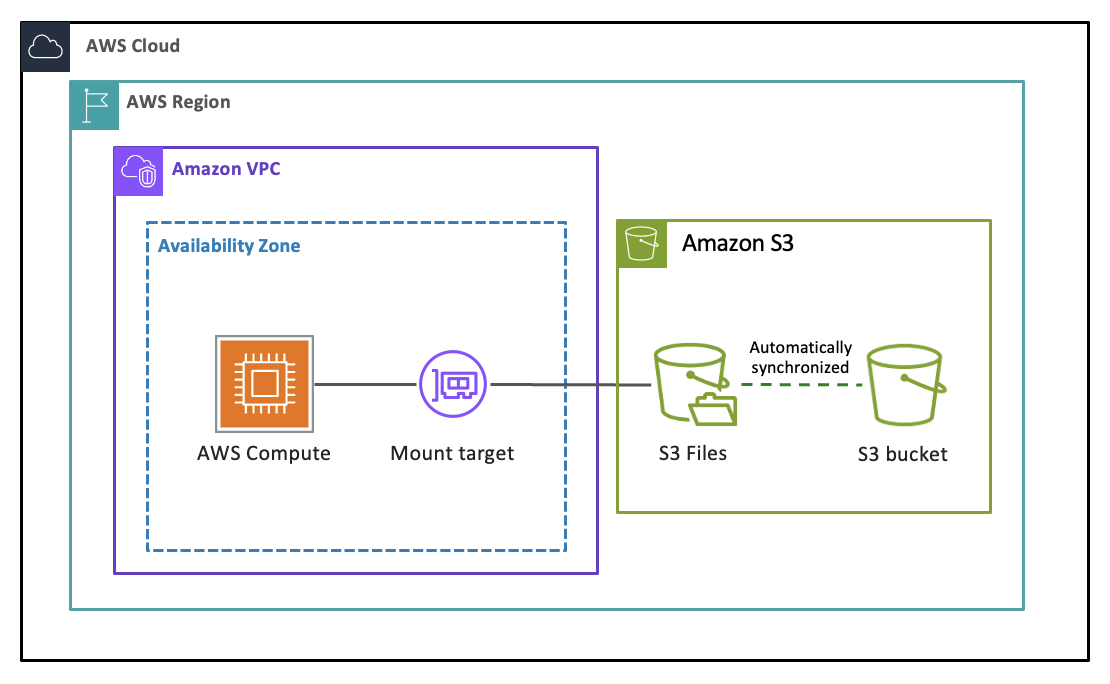
Key architectural characteristics:
- S3 Files uses EFS as a caching and metadata layer.
- It does not split files into chunks, preserving one-to-one file-object mapping.
- Only files smaller than a threshold (configurable, defaulting to 128 KiB) are placed in the EFS high-performance tier during data import.
- Large files are read directly from S3 via "passthrough" reads.
- There is an aggregation window of up to 60 seconds before writes are synced back to S3.
JuiceFS adopts a decoupled architecture that separates metadata management from data storage. Files are split into blocks (default 4 MiB) before being uploaded to object storage, with corresponding metadata stored in a separate database engine.

Key architectural characteristics:
- JuiceFS supports pluggable metadata engines (Redis, TiKV, MySQL, PostgreSQL, etc.)
- JuiceFS stores files using data chunking, which enables efficient partial updates, appends, and high-throughput operations. For more details, see Architecture.
- No dependency on EFS or any intermediate storage layer. However, JuiceFS supports a flexible caching mechanism to decrease latency and improve performance.
- Multi-cloud and hybrid cloud support with all mainstream object storage backends.
Data path and latency
S3 Files: The EFS high-performance tier handles all metadata operations and small-file data access. On the other hand, large file reads go straight to S3. This hybrid path means that the latency it takes to read a file varies a lot depending on the file size and its access pattern. Write amplification can become severe for large-file partial updates and renaming operations (more details below).
JuiceFS: Metadata operations interact with the dedicated metadata engine with a configurable metadata cache layer, providing rapid responses independent of object storage latency. Data reads and writes leverage local caching and chunk-based distribution. The JuiceFS Client can intelligently cache both metadata and data blocks, reducing round trips to the metadata engine and object storage.
Write efficiency
S3 Files: Due to the one-to-one mapping between files and objects, S3 Files has to rewrite or version all of the objects when performing random writes or appends on large files. For instance, appending 100 KB to a 100 GB file incurs considerable write amplification and storage expenses. Similarly, directory renaming on directories with millions of objects requires rewriting each object to a new location with a new key and deleting the original ones, dramatically increasing both operation time and S3 request costs.
JuiceFS: Because files are split into blocks, rewriting or appending data to a large file only affects those blocks. This greatly reduces time and bandwidth waste, regardless of file size. Directory renaming is a metadata-only operation, making it efficient even for directories containing millions of files.
Caching
S3 Files uses EFS as its high-performance storage and caching layer, and the cache behavior is fully managed by AWS. S3 Files automatically evicts data that has been synchronized to S3 and not accessed for a configurable period (default 30 days) from the EFS tier. Users do not have direct control over the cache capacity. Instead, files promoted into the EFS tier are controlled by the configured file size threshold. This creates a trade-off between file access latency to meet your workload requirements and the ongoing EFS read, write, and storage costs. Besides, users can directly modify or rewrite an underlying object in S3, which results in eventual consistency, where the version in the S3 bucket always takes precedence.
JuiceFS implements client-side caching on local SSDs or memory. It defines a default limit for the disk cache of 100 GiB, which users can freely adjust. When cache usage reaches the limit, JuiceFS automatically cleans up using an LRU-like algorithm, ensuring cache space remains available for subsequent operations. For more details, see Cache.
Multi-cloud support
S3 Files integrates seamlessly with existing S3 buckets, making it a natural choice for teams already invested in AWS as their infrastructure provider. However, S3 Files is a single-cloud solution. If your organization needs workload portability across AWS, Azure, GCP, or private clouds, JuiceFS offers a consistent file system interface that works with any mainstream underlying object storage provider. See the table below for more details.
Feature comparison
| Features | S3 Files | JuiceFS Community Edition | JuiceFS Enterprise Edition |
|---|---|---|---|
| Clients | POSIX (FUSE) + S3 direct access | POSIX (FUSE), Java SDK, Python SDK, S3 Gateway | POSIX (FUSE), Java SDK, Python SDK, S3 Gateway |
| Metadata storage | EFS | External database (Redis, TiKV, MySQL, PostgreSQL, etc.) | Horizontally-scalable high-performance distributed metadata engine |
| Metadata redundancy | Provided by EFS | Depends on the database used | At least 3 copies (based on the Raft consensus algorithm) |
| Data storage | S3 only | Any mainstream object storage or other types of storage | Any mainstream object storage or other types of storage |
| Data redundancy | Provided by S3 | Provided by the data storage layer | Provided by the data storage layer |
| Data caching | EFS | Local cache | Memory + local cache + distributed cache |
| Encryption | ✓ Supported | ✓ Supported | ✓ Supported |
| Compression | ✕ Not supported | ✓ Supported | ✓ Supported |
| Quota management | ✕ Not supported | ✓ Supported | ✓ Supported |
| POSIX compliance | ✓ Fully compatible | ✓ Fully compatible | ✓ Fully compatible |
| POSIX ACL | ✓ Supported | ✓ Supported | ✓ Supported |
| Kubernetes CSI | ✓ Supported | ✓ Supported | ✓ Supported |
| Cross-region replication | ◐ Relies on S3 | ◐ Relies on external service | ✓ Supported |
| Multi-cloud mirroring | ✕ Not supported | ✕ Not supported | ✓ Supported (with no extra cost for private deployments) |
| Pricing | S3 + S3 Files pricing | Open source and free (Apache License 2.0) | Commercial license, volume pricing |
Cost implications
S3 Files introduces additional cost layers beyond standard S3 storage:
- S3 costs.
- EFS high-performance tier storage fees for active data ($0.30/GB-month in popular US regions).
- Data flow costs: In popular US regions, reads from the EFS tier cost $0.03/GB. Writes first land in the EFS tier ($0.06/GB) and then sync back to S3, which involves additional reads from the EFS tier again ($0.03/GB).
- Short-term data residency: Even after synchronization completes, data continues to occupy EFS capacity until the expiration period (default 30 days).
For write-heavy workloads such as generating training datasets or analysis outputs, these costs can accumulate rapidly. S3 Files is better suited for reading existing data, especially for small files. On the other hand, when it comes to sustained, large-scale file reads and writes, particularly for modifying or appending to large files, S3 Files can be costly and less performant. For more details, refer to the pricing page for S3 and S3 Files.
JuiceFS costs are more transparent and user-controlled:
- Object storage costs.
- Metadata engine costs: self-hosted or fully managed metadata service (independent database or JuiceFS Enterprise Edition metadata engine).
- No mandatory intermediate tier or data flow surcharges.
- For cost-sensitive, read-heavy, write-heavy, or multi-cloud scenarios, JuiceFS typically incurs lower incremental costs than S3 Files.
Summary
Amazon S3 Files adopts a storage architecture that uses Amazon EFS as a high-performance metadata and caching layer on top of S3. By preserving direct object-to-file mapping without chunking, it enables zero-to-minimal migration access to existing S3 buckets through the standard NFS protocol. The built-in bidirectional sync between the file system view and S3, combined with sub-millisecond latency for active working sets, makes S3 Files very suitable for AWS-native interactive workloads, agentic AI tools, and scenarios where teams need to mount existing S3 data as a shared file system without code changes or data copying.
JuiceFS supports tens of object storage backends, including AWS S3, Azure Blob, Google Cloud Storage, MinIO, and Alibaba Cloud OSS, as well as HDFS and local disks as data storage engines. It supports popular databases such as Redis, Valkey, TiKV, MySQL, MariaDB, PostgreSQL, and SQLite as metadata storage engines. The JuiceFS Enterprise Edition also offers a proprietary, highly scalable distributed metadata engine. JuiceFS provides a standard POSIX file system interface through FUSE, a Java API for Hadoop ecosystems that can directly replace HDFS, and a Kubernetes CSI Driver for container persistent storage. By splitting files into smaller blocks and decoupling metadata from data, JuiceFS enables efficient random writes, fast directory operations, and strong consistency without write amplification. JuiceFS is a file system designed for enterprise-level distributed data storage scenarios. It is widely used in various scenarios such as big data analytics, AI/ML training, agentic AI tools, multi-cloud and hybrid cloud deployments, container shared storage, and high-performance computing.