


As multimodal AI and model training continue to scale, AI data pipelines must handle increasingly large and diverse datasets. A training job may need only a few fields but still has to filter and read from a massive dataset. When data is distributed across multiple clouds and data centers, compute nodes may also sit idle while waiting for data due to access latency.
This creates two challenges:
- How can we reduce unnecessary data reads?
- How can we deliver the data that training jobs need to compute nodes in time?
This article explores how Lance and JuiceFS address these challenges and when it makes sense to use them together. We'll first look at the roles each plays in an AI data pipeline, then examine when direct access to object storage is sufficient and when adding JuiceFS can improve data delivery. Finally, we'll walk through a production architecture from an autonomous driving company to see how Lance and JuiceFS work together to support large-scale data processing and GPU training across multiple clouds.
What problems do Lance and JuiceFS solve?
Lance is an open source table format for multimodal AI. It provides columnar storage, multimodal schemas, vector indexes, and versioning to help users organize data such as images, videos, text, and embeddings. Its focus is on what data a task needs and how to avoid reading irrelevant data.
Consider autonomous driving data as an example. A single sample may contain many annotation attributes, but a training job typically uses only a subset of them. With columnar storage, a job can read only the fields it needs, reducing unnecessary data reads. It also makes annotation attributes easier to update and extend.
JuiceFS is a high-performance distributed file system designed for cloud-native environments. It sits between applications and object storage, providing data access to compute workloads through POSIX-compatible interfaces, local caching, data warm-up, and a unified namespace. Its focus is on how to deliver the data workloads needed to compute nodes reliably and with minimal delay.
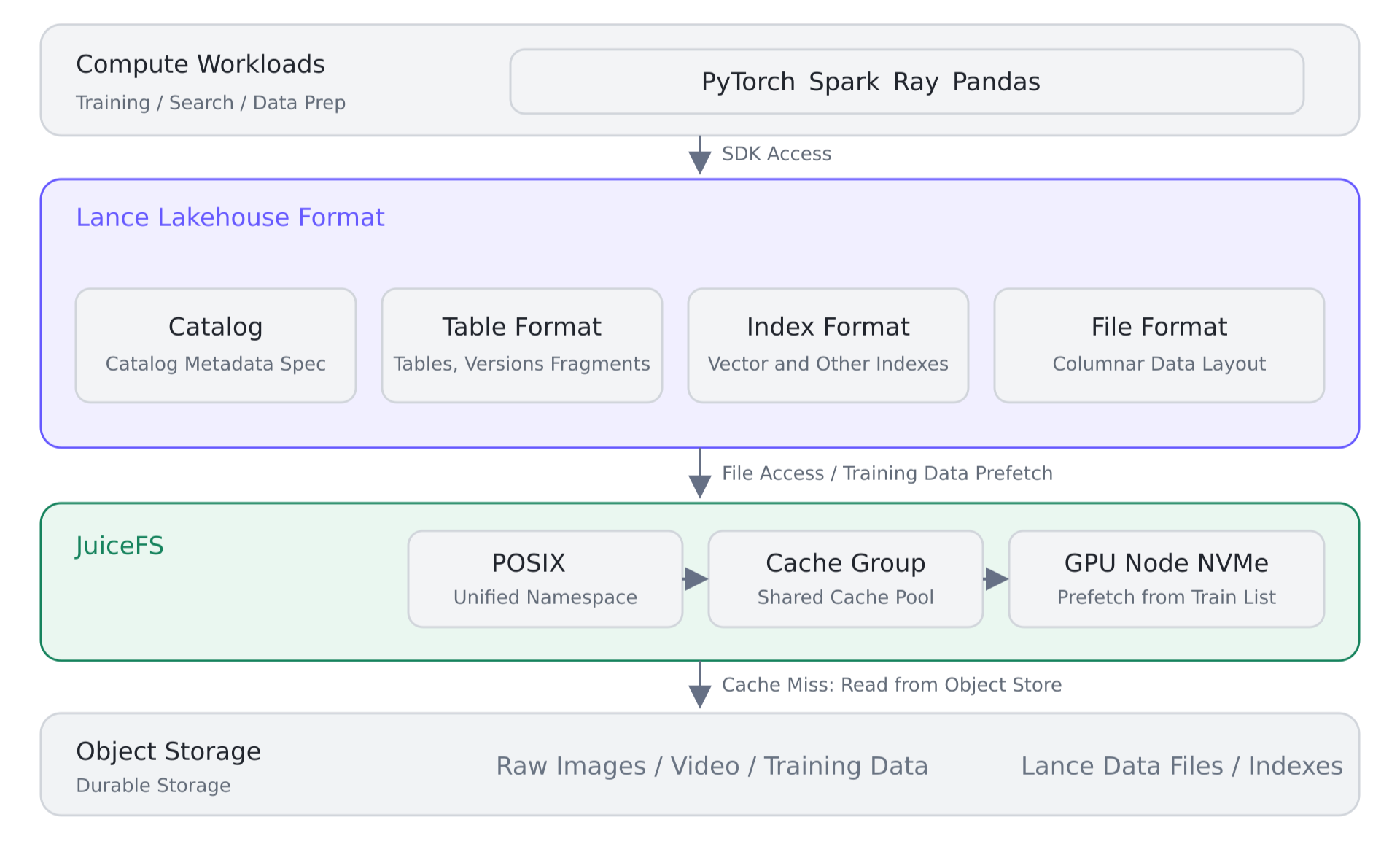
In short, Lance reduces how much data needs to be read, while JuiceFS reduces how long workloads have to wait for data.
If you have Lance, do you still need JuiceFS?
If you have Lance, do you still need JuiceFS? The answer depends on the workload. Three factors are particularly important:
- How latency-sensitive the task is
- Whether I/O is the primary bottleneck
- How costly GPU idle time is
Vector search, data annotation, and offline analytics
For vector search, data annotation, and offline analytics, connecting Lance directly to object storage is often sufficient.
There are two main reasons:
- These tasks are generally not latency-sensitive. For example, an additional wait of several dozen seconds may have little impact on an offline search job.
- I/O may not be the primary bottleneck. In some vector search workloads, searching for the top 20,000 results across 100 million rows takes approximately 20 seconds. CPU-based vector computation accounts for most of that time, while I/O and network access contribute only a small portion. Adding a caching layer would therefore have a limited impact on overall performance.
Data production and GPU training
JuiceFS becomes more valuable when I/O is the primary bottleneck.
GPU training workloads differ from offline search because GPU resources are expensive. If large numbers of GPUs sit idle while waiting for data, the resulting cost can far exceed the cost of adding a caching layer. This is especially true in multi-cloud and multi-data-center environments, where GPU nodes may need to access object storage across cloud boundaries. Direct network access to remote object storage can introduce high latency and performance fluctuations, reducing training efficiency.
JuiceFS addresses this by bringing data closer to compute nodes. Local caching and data warm-up allow training jobs to read data locally as soon as they start. This reduces direct access to remote object storage, helping minimize cross-cloud latency and performance fluctuations.
A production case from a leading autonomous driving company: Lance + JuiceFS
A leading autonomous driving company uses a Lance + JuiceFS + object storage architecture to support large-scale autonomous driving data processing and model training.
This workload has several characteristics:
- Data is distributed across multiple cloud environments and data centers.
- Annotation data spans billions of rows and continues to grow.
- Both data production and model training generate substantial I/O demand.
During data production, the main challenge is read amplification. Traditional workflows often use LMDB. Each record contains extensive annotation information, but a given task may need only a small subset of those fields. Reading the entire record every time loads large amounts of data that the task does not use. Updating or adding annotation fields can also increase maintenance overhead.
Lance's columnar storage allows tasks to read only the fields they need. The original files remain in object storage, while Lance manages indexes and related metadata. This reduces the amount of data read and makes it easier to evolve annotation attributes.
During model training, the main challenge is the wait time caused by cross-cloud access. If GPU nodes read directly from remote object storage, network latency can prevent data delivery from keeping pace with computation.
To address this, the company adds a JuiceFS caching layer between Lance and object storage. Lance manages the data and generates the training list. JuiceFS uses that list to prefetch training data into local NVMe caches on GPU nodes. Once training starts, most data can be read from the cache, while data that has not been prefetched is fetched from object storage on demand.
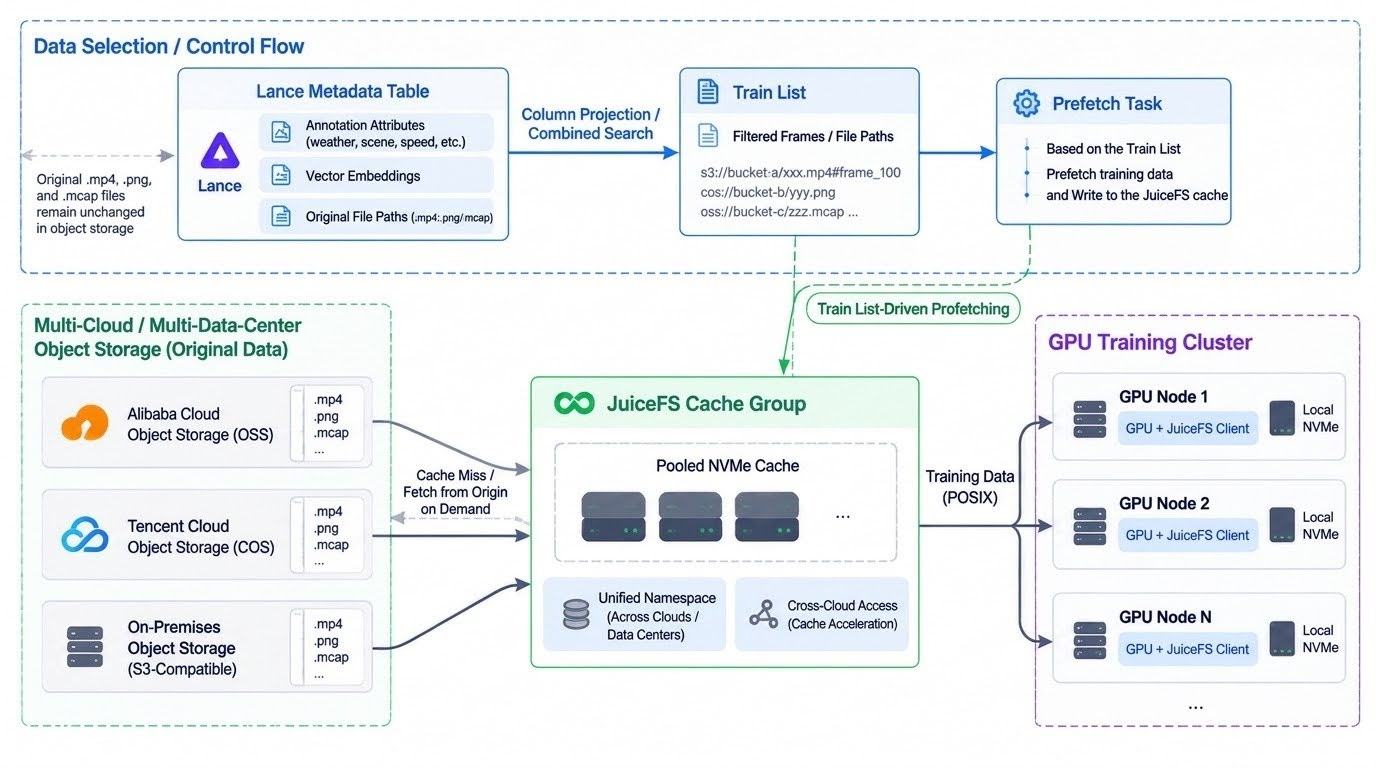
The workflow can be summarized as follows: Object storage holds the original data, Lance organizes and filters it, and JuiceFS delivers the data needed for training to compute nodes.
Conclusion
Whether Lance and JuiceFS are worth combining depends on whether two bottlenecks occur together:
- Read amplification: A task needs only a few fields but loads large amounts of irrelevant data.
- Access latency: GPU training across multiple clouds and data centers leaves compute resources idle while waiting for data.
The combination delivers the greatest value when both bottlenecks are present and I/O is the primary performance constraint.
JuiceFS has begun supporting fine-grained data prefetching for Lance datasets, further connecting data organization with cache acceleration. For details, see the related pull requests: JuiceFS #7398 and JuiceFS #7399.
Lance + JuiceFS is still a new combination, and publicly documented production deployments and case studies remain limited.
If you have any feedback on this article or ideas to share, we invite you to participate in the discussions on GitHub and join the JuiceFS community on Discord.
