The new root user
For decades, this single sentence defined the core Unix philosophy. Today, the primary operator interacting with those files is no longer a human at a terminal but an autonomous LLM agent spinning up environments, editing code, and executing scripts.
Because LLMs were pre-trained on codebases, wiki pages, documentation, directory trees, and terminal logs, POSIX file system operations serve as the zero-friction API for agentic reasoning. Giving an agent access to a familiar workspace lets it leverage standard developer tools immediately.
The following is an example output of an AI agent performing code reviews:
# Verified, the following command returns only the method definition.
# Your change doesn't have any actual invocation of this method.
grep -r "store.addDelayedStaging" . --include="*.go"
However, while a classic POSIX interface is necessary, modern AI agents demand far more from their storage than standard local file systems were built to deliver. To support a massive number of ephemeral, fast-moving agent sessions, the underlying storage layer must evolve as well.
Architectural paradox
This shift introduces a fundamental storage paradox for AI infrastructure engineers:
-
At the surface layer: The agent requires a workspace that strictly behaves like a classic, local POSIX file system so that standard developer tools (
git,python,grep, compilers, etc.) function seamlessly without custom glue code. -
Under the hood: Traditional instance-bound storage breaks down when managing hundreds or thousands of ephemeral, short-lived, or parallel agent sessions. The underlying backend must provide remote snapshotting, consistent multi-agent concurrent access, elasticity, and scalability while still being compatible with that familiar file interface.
To build scalable infrastructure for autonomous AI agents, we must preserve the classic Unix interface while completely re-engineering the storage engine beneath it.
Why AI agents love the file system
If APIs are rigid software contracts, POSIX file systems are the open playground. Giving an LLM agent direct access to a file system workspace unlocks operational advantages that structured tool calls simply cannot match.
Offloading the context window
Even the most advanced models with million-token context windows experience severe latency, high costs, and performance or attention degradation when a massive repository or gigabytes of build logs are included in an LLM prompt. The file system serves as secondary memory, allowing the agent to store raw state externally and selectively read, seek, or stream only the relevant fragments it needs at runtime.
The universal abstraction
A file system requires zero protocol overhead when an agent has shell execution access, unlike external services or database integrations that need custom JSON schemas or Model Context Protocol (MCP) tool wrappers. LLMs already possess a profound understanding of standard file operations and directory navigation out of the box. Exposing a POSIX file system gives the agent a universal workspace across any language, framework, or file format, without needing to define or maintain a single custom tool schema.
Unlocking the Unix ecosystem
By granting an agent a file system, it immediately inherits decades of battle-tested CLI tools: grep, awk, git, sed, compilers, and static analyzers. Rather than inventing "AI-native code search," an agent can simply execute grep or analyze git diff using tools already optimized for speed and scale.
Database-driven metadata meets elastic storage
When building agentic platforms, the naive approach is to rely on local block storage attached directly to a compute instance (e.g., standard ephemeral instance disks or container volumes). While simple initially, instance-bound disks rapidly fail under the demands of autonomous agents:
-
Ephemeral state loss: When an agent container scales down, crashes, or migrates to another host, all workspace state and context stored on instance-tied disks are lost unless manually synced.
-
Concurrent data access: Multi-agent workflows often require sub-agents (e.g., a planner, coder, and reviewer) to operate on the same repository simultaneously. Instance-attached disks cannot safely allow multi-node concurrent reads and writes without file lock corruption or race conditions.
-
Non-native data backup: Compute-instance disks lack built-in data backup or snapshotting, which makes rolling back the environment after an agent error slow and expensive.
To overcome these constraints, modern agent file architectures decouple the metadata engine (directory trees, permissions, file locks, and state) from the data storage layer (file payloads).
By backing the metadata layer with specialized database engines and offloading raw file blocks to elastic object or remote storage, file system operations essentially become database queries. The agent gets the exact POSIX semantics its tools expect, while the infrastructure gains consistency guarantees, automatic backups, and infinite horizontal scale.
The ecosystem landscape
Innovative projects across the storage industry demonstrate how database backends are powering this new era of AI agent file storage. Here, we are exploring a few notable approaches.
Lightweight embedded approach: AgentFS with SQLite
AgentFS, developed by Turso, embodies the lightweight embedded approach within the database-as-file-system paradigm. Designed specifically for agent sandboxing, it stores every piece of runtime state (file operations, key-value entries, and tool call histories) in a single SQLite database. The underlying engine is Turso, a full rewrite of SQLite in Rust that adds native asynchronous I/O and concurrent access, with optional cloud sync for portability across environments.
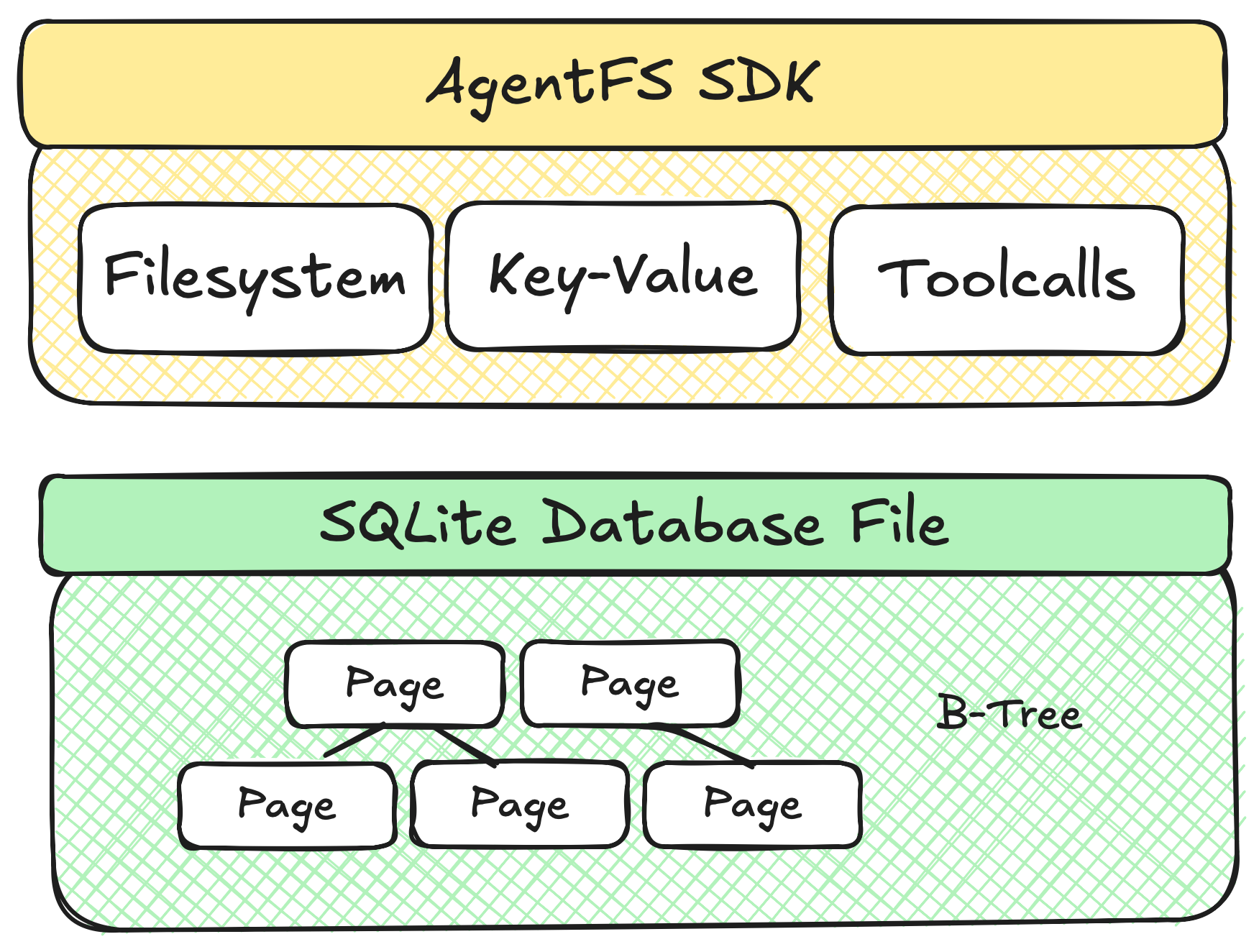
AgentFS exposes a POSIX-like virtual file system via an SDK or a FUSE mount. This unified storage foundation delivers copy-on-write isolation for safe agent execution, instant SQL-queryable audit trails for debugging and compliance, and single-file snapshots that make agent state trivial to share, version, and reproduce.
Client-server transactional approach: TigerFS with PostgreSQL
TigerFS, developed by Timescale, mounts a PostgreSQL database as a transactional file system over FUSE (Linux) or NFS (macOS). Every file maps to a row, directories map to tables, and file contents become columns. Every write is a full ACID transaction, enabling multiple agents and humans to read and write the same files concurrently with true ACID guarantees.

Multi-agent task coordination becomes as simple as moving a file (`mv task.md ./doing/`), with PostgreSQL transactions natively preventing race conditions without custom API orchestration. TigerFS offers two modes: file‑first for workspaces with atomic writes and reversible savepoints, and data‑first for exploring existing databases with Unix tools like `ls`, `cat`, and `grep`, with filters pushed down as SQL. Every change is versioned and fully reversible, and the file system itself serves as the API.
Decoupled distributed approach: JuiceFS with object storage
JuiceFS takes a fundamentally different architectural path: it decouples metadata and data storage entirely. File data is split into chunks and stored in S3-compatible object storage, while metadata lives in a separate, pluggable engine, supporting Redis, MySQL, PostgreSQL, TiKV, SQLite, JuiceFS Enterprise Edition (EE) metadata engine, and more. This separation enables JuiceFS to deliver strict POSIX compliance alongside shared, multi-node concurrent access, allowing hundreds of agent instances to safely work across a shared workspace. JuiceFS can be connected using FUSE, Kubernetes CSI, or SDKs (like Python, Hadoop, and S3 gateway), which makes it a flexible storage option for agents as well as other AI processes, including data preparation, model training, and deployment in different regions. Every committed change is immediately visible across all mounts with strong consistency, and the system scales elastically with object storage economics.
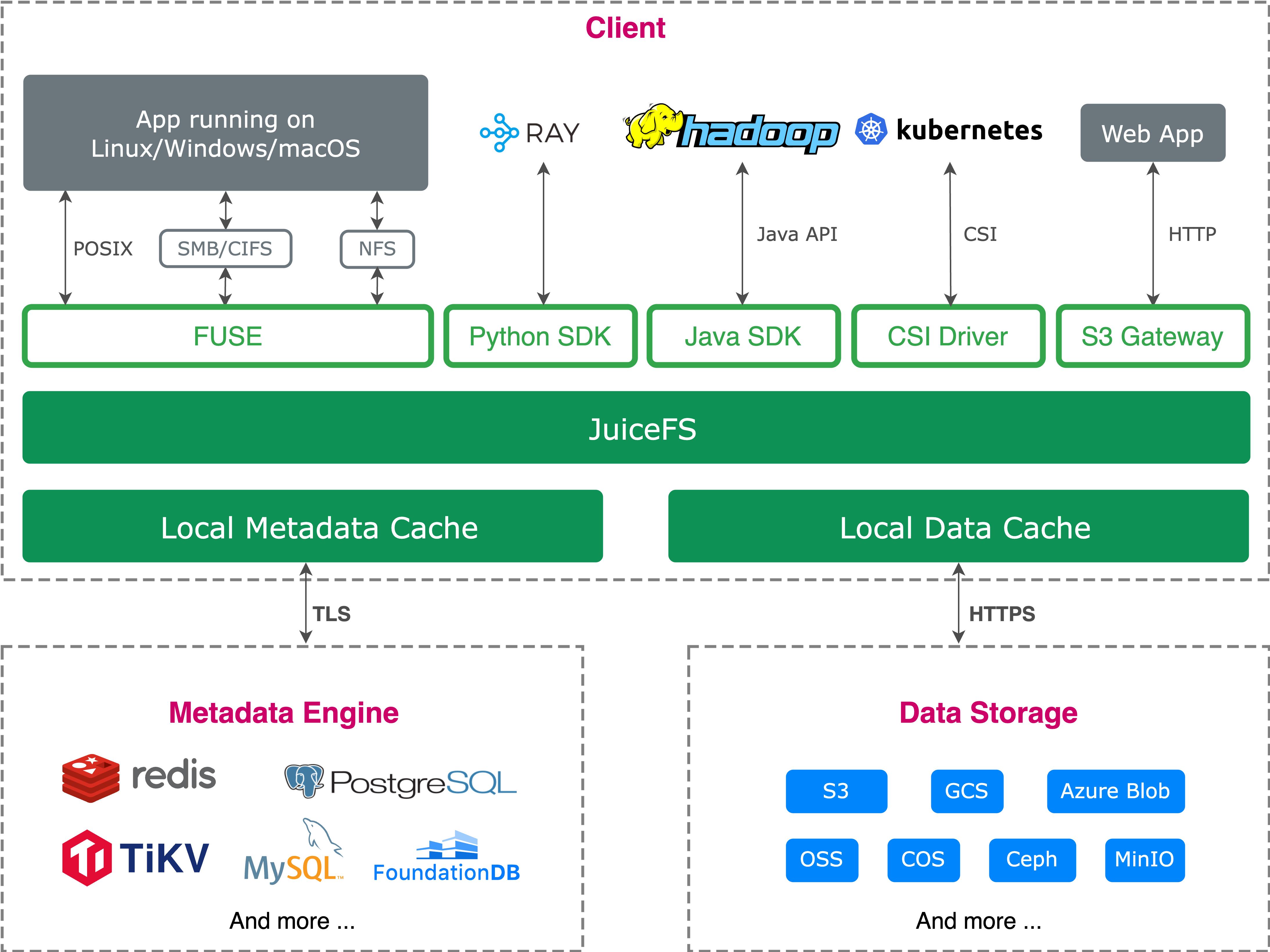
Together, projects like AgentFS, TigerFS, and JuiceFS represent distinct architectural explorations in the quest to provide agents with a persistent, shareable file system. Each tackles the problem from a different angle, yet all share a common recognition: agents naturally work with files. There is no clear consensus on which approach will become the dominant standard, and perhaps no single winner exists. What is certain is that the file system is re-emerging as a core primitive for AI agent orchestration, precisely because the POSIX interface aligns so naturally with how agents read, write, and organize data, and ultimately because agents complete tasks by acting on data and files.
Agents' full toolbox
While a database-backed file system provides a zero-friction home for code and context, a file system alone isn't enough for complex enterprise workflows. Real-world agents also need to orchestrate across multiple systems of record, for example:
-
The file system: As discussed above, the file system serves as the primary workspace for source code, local logs, build artifacts, and raw data manipulation.
-
Databases & APIs: The structured state layer for transaction logs, vector search embeddings, and relational data that models need to query or update.
-
The Model Context Protocol (MCP): An open standard protocol that standardizes how LLM applications connect to external data sources and tools through MCP servers. It does not replace existing APIs. Instead, it provides a common interface and transport layer on top of them so clients can discover and use capabilities without custom integrations for every application or model.
By combining elastic file workspaces with standardized protocols like MCP, developers can build agents that are autonomous, practical, and powerful.
Final thoughts
We aren't just building sandboxes anymore. Instead, we are designing a new type of operating system. In this model, the LLM acts as the CPU, the context window is the fast L1 cache, and database-backed file systems serve as persistent NVMe drives.
The industry is still actively debating what an agent's ultimate memory architecture should look like: whether it should rely on vector databases, structured state stores, or file-based paradigms. While the ideal abstraction may continue to evolve, the file system is already proving to be a core foundation in agent infrastructure. Let's honor the classic Unix philosophy and give agents seamless access to decades of battle-tested software tools through a familiar POSIX interface and the performance and scale that modern distributed backends deliver.
If you have any feedback on this article or ideas to share, we invite you to participate in the discussions on GitHub and join our community on Discord.